
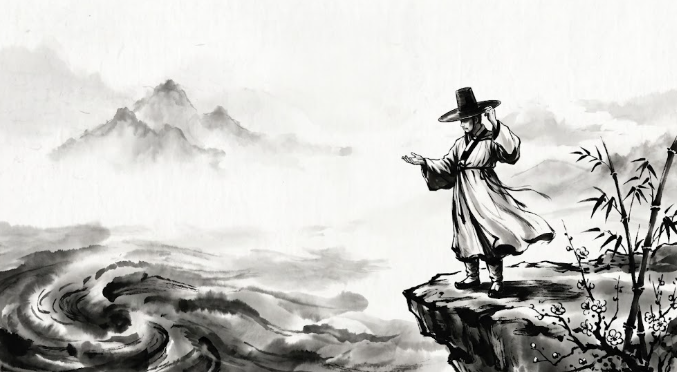
Introduction: The Wisdom of Tian, Di, and Ren (天地人) Found Before a Shattered Portfolio
In the ruthless battlefield of capitalism, my portfolio was brutally halved three times. On the nights when everything collapsed, I was a loser trapped in a dark room, blankly staring at the red and blue numbers plummeting on my monitor. Amidst that hellish agony and sense of loss, as if the world had ended, what brought me back to an ordinary and peaceful life was not the complex quant techniques or flashy chart analysis of Wall Street. It was the ancient Eastern wisdom of the I Ching (Book of Changes), Musoyou (Non-possession), and Zen.
Only after letting go of greed and returning to a quiet life did the quotes of great investment gurus begin to take on a completely different dimension.
“Buy low, sell high.” In the past, I thought this was just a sophisticated trading technique to catch perfect timing like a machine. I was wrong. The true meaning of this phrase was to cultivate the ‘inner control to be satisfied’—the courage to buy when others throw away in fear, and the discipline to walk away with only your share without lingering attachment when others shout in euphoria that it will go higher. It was not a matter of technique, but of mental discipline.
Furthermore, gurus like Warren Buffett and Peter Lynch didn’t become suddenly wealthy by hitting the perfect timing through sheer luck. They simply captured immense wealth because, like a hollow bamboo, ‘they silently remained in the market no matter what happened,’ through violent storms or warm sunshine.
The I Ching speaks of three great principles of the universe: Tian (Heaven), Di (Earth), and Ren (Humanity).
- Ren (Humanity): The way of humans. It is the mindset of constantly studying the economy, disciplining one’s mentality, and establishing an unwavering philosophy.
- Di (Earth): The environment of the ground. A solidly built portfolio and asset allocation principles that allow you to stand firm in any market crash.
- Tian (Heaven): The fortune of the sky. The massive flow of macroeconomics and explosive timing of returns, completely beyond human control.
I finally realized: The investment gurus were not gamblers chasing Tian with god-like predictions. They were individuals who coldly disciplined their minds to build ‘Ren’ and firmly established ‘Di’ with unshakable principles. Then, they quietly waited for ‘Tian (Opportunity)’, granted by the heavens, to naturally come to them. This is the true reason why investing must be embraced as a profound ‘discipline’ of life, not a shallow technique.
1. The World is Fair, but Capitalism is Never Fair
Everyone is born empty-handed and returns to a handful of dust. If there is a buyer of a stock, there is inevitably a seller. Before the final door of death, a homeless person shivering on the street and a billionaire in a New York penthouse are exactly equal. Viewed purely through the massive cycle of nature, the world is remarkably, almost indifferently, fair.
However, this ‘capitalist’ system we breathe and live in is by no means fair. Why is that? The cruelest reason capitalism makes us feel wronged is not simply because of the size of our initial seed money. It is because, by constantly adjusting ourselves to the price tags and shallow standards of success set by the world, we eventually completely lose sight of our unique essence—’who we truly are.’
When blinded by impatience and greed to add a few more digits to our accounts, we fail to pierce through the hidden ‘Meaning’ in the massive market flows, and repeatedly miss the brilliant ‘Timing’ to boldly bet or step back.
To reclaim our ‘lost selves’ in this maddening cycle of capital, the first compass we must firmly grasp is the teaching of ‘Non-possession’ (무소유). To a Seonbi (a classical scholar), non-possession does not mean denying capitalism and living in poverty. It means ‘gently letting go of unnecessary attachments born from endlessly comparing our returns with others, so our souls are not consumed by the numbers in our portfolios.’ When we empty our impatience to beat others and make our inner selves a hollow vessel, we finally gain the eyes of insight to transparently reflect the true nature of the market.
2. The Insight to Read the ‘Meaning’ of Things and Catch the ‘Timing’
The fundamental reason so many suffer bitter defeats in investing is that they have lost their inner stillness due to a gaze turned exclusively outward. Consider a very simple and relatable everyday example: ‘a cold can of beer and a funny TV show.’
Imagine someone lying on a plush sofa after a hard day of work, drinking a cold beer, watching an entertaining variety show, and laughing. In that moment, that person has reached the ‘most relaxed and defenseless state (Meaning),’ having completely lowered all the brain’s defense mechanisms.
If you had to make a heavy request or an important proposal that you normally wouldn’t dare bring up, when would be the best moment? Paradoxically, this exact moment, when the other person is most defenseless, becomes the most perfect and sharp ‘Timing.’ A state where the mind is relaxed and comfortable is exactly when one’s inner capacity expands the most. It becomes a magical moment where even a burdensome proposal or truth, which would normally be flatly rejected, is generously accepted.
The global capital market meshes with this everyday logic perfectly, like cogwheels. To grasp the true psychology of the masses hidden behind the countless indicators spat out by the market, you need the still mind of ‘Zen’ (선)—the ability to completely shut your eyes and ears when others are blinded by euphoria during a rally or screaming in terror during a horrific crash. Only those who do not blindly follow the herd psychology and stand firm like a mountain in their core can firmly grasp the ‘Timing’ of opportunity in the ashes of a crash, where others have screamed, dumped their assets, and fled.
3. The Four Gracious Plants (四君子): A Survival Guide for the Four Seasons of Capitalism
The stock market has four seasons. After a summer of greed that feels like it will rise forever, a winter of fear, where all assets freeze over, inevitably arrives. To find our lost selves and peacefully survive this harsh cycle, we must engrave in our hearts the clear and solid character of the ‘Four Gracious Plants’ (Sagunja – Plum Blossom, Orchid, Chrysanthemum, Bamboo), which the ancient scholars kept as lifelong companions.
- The Noble Patience of the Plum Blossom (매화): When a credit crunch hits and a brutal Bear Market crashes asset values, those without a center frantically dump their stocks at the bottom and flee. But one who has found oneself within capital silently holds their ground like a plum blossom quietly preparing for spring at the tip of a barren branch. The patience to endure with clear, cold reason when everyone else is swept away by despair—that is the ‘root of the ego’ that conceives the miracle of compounding.
- The Silent Nobility of the Orchid (난초): A spring of madness, where massive liquidity is released and all sorts of Meme Stocks and speculation run rampant. When others boast of becoming overnight millionaires, you must not lose your pace to FOMO (Fear Of Missing Out). Like an orchid emitting a noble fragrance alone in the crevice of a deep forest rock, the perseverance to silently maintain your own asset allocation principles without swaying to the greed of the crowd is the elegance of the orchid.
- The Unwavering Integrity of the Chrysanthemum (국화): In late autumn, when a seemingly endless rally breaks and the bubble begins to pop, you must live like a chrysanthemum that blooms its bright yellow petals alone amidst the biting frost. When others are swept away by the market’s whims, abandoning their principles to jump into the gambling pit, you need the integrity to never discard your philosophy against any temptation or pressure, staying in the market to the very end to reap a heavy harvest.
- The Wise Flexibility of the Bamboo (대나무): An arrogant investor who stands stiffly, believing they can perfectly predict the market, will snap before a massive economic crisis. However, a hollowed-out bamboo does not fight the fierce typhoon; it willingly lowers itself, flexibly bending to the direction of the market. The flexibility to not go against the market but naturally ride its flow is the greatest survival strategy in capitalism.
Conclusion: The Path to Standing as a Complete Self in Capital
The secret to being the ultimate victor in the vast ocean of global capitalism is not the arrogance of forcefully fighting and beating the market with flashy algorithms and mathematical techniques. It is the noble and beautiful process of keeping the compass of philosophy and protecting your ‘true self’ even in the fierce vortex of money.
Become the Bamboo that willingly and flexibly matches the rhythm of endless, turbulent volatility without fear. Empty your mind like the Orchid, not rejoicing or grieving over the return rate in your account and not comparing yourself to others. Become the Chrysanthemum that looks at inner stillness and maintains its center the more the market boils over with noise and greed. And no matter how long and dark the winter of a bear market becomes, be the Plum Blossom that ultimately overcomes the blizzard and preserves its philosophy.
If we discipline our inner selves to cultivate the Way of Humanity (Ren), solidify the ground (Di) with firm principles, and dwell there, the Way of Heaven (Tian)—which brings immense wealth—will naturally find us when the time comes.
Now, quietly calm your boiling mind and ask yourself this heavy and profound question:
“As you navigate the jungle of capitalism that forces endless expansion upon us, is what you truly seek in this moment the fleeting numbers blinking on a monitor, or a solid ‘self’ that harbors a noble fragrance, never breaking even in the harsh financial blizzards of the four seasons?”