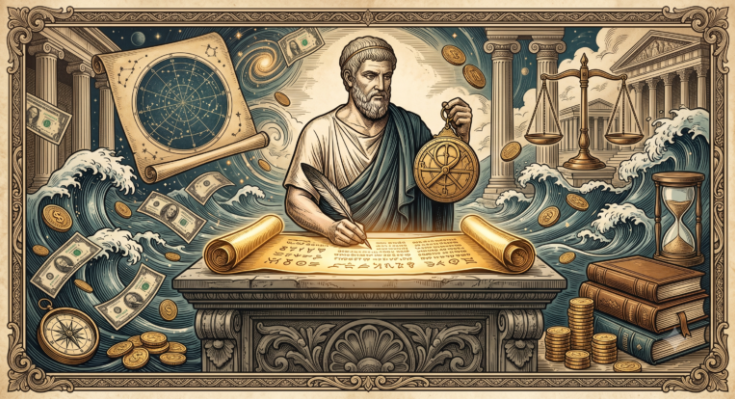
Introduction: The Magic of Categorization That Rules Our Daily Lives
I couldn’t help but wonder: why did humans divide time into categories like Monday through Sunday, the four seasons of spring, summer, autumn, and winter, and the twelve months from January to December? There is a clear reason why rulers and astronomers since ancient times put their heads together to construct these frameworks.
“The moment we assign meaning and partition time into categories, the boundless and seemingly uncontrollable force of natural time steps into the comfortable, predictable realm of our daily lives.” Upon the linear and equal structure of time—an additive progression that no one can manipulate or alter—we have overlaid meanings of our own design.
We are all taught the categories of time, yet no one clearly explains why it was broken down so minutely in the first place. Could these meticulous divisions actually be a dense and sophisticated veil, designed to keep us from confronting the vast, raw essence of time itself?
1. How to Grasp the Essence: The Similar and the Opposite
To grant true meaning to any substance or situation, one must grasp its ‘essence.’ The most powerful philosophical tool for understanding essence is to place the ‘similar’ and the ‘opposite’ side by side and contrast them.
Take ‘rest,’ a common concept in daily life. To understand the true essence of rest, we must contrast it with ‘sloth’ (the similar) and ‘overwork’ (the opposite).
When we draw a line between aimless sloth that idles away and endless overwork that drains energy, we realize that rest is not a passive neglect of slacking off. Rather, it is “a time to compose exhausted reason and isolate the soul from external noise to quietly restore oneself for the next leap.”
The same applies to money. To grasp the essence of genuine ‘investment,’ one must place ‘speculation’ (the similar) and ‘neglect’ (the opposite) side by side for comparison. Money is neither something to blindly chase nor something to leave abandoned; it is “a shield and tool to safeguard the independence and autonomy of one’s life amidst external turbulence.”
We can apply the exact same yardstick to time.
Amidst the closely divided hands of the clock and calendar entries, to capture the true essence of time, we must contrast ‘control’ (the similar) with ‘licentiousness’ (the opposite).
It is the boundary between ‘control’—where a massive system strips away an individual’s sovereignty and current moment—and ‘licentiousness’—where time is squandered without purpose. When we draw a line between these two extremes, the essence of time finally reveals itself: “living as the true master of one’s life in ‘this very moment,’ which must neither be stolen nor thrown away.”
I served as a military officer for 6 years, ultimately choosing discharge after being exhausted by a controlled life and overwork. At the time, I left in pursuit of freedom, but today, I hold immense pride in those 6 years, knowing that I protected someone for that entire duration of 6 years. As such, even the essence of things ultimately transforms according to one’s perspective.
Is your time being stolen, or are you living as its master in this very moment?
2. Giving Meaning to the Most Important Capital, ‘Money’ (Rockefeller’s Ledger A)
If we have assigned meaning to time for the sake of our lives, we must perform this process all the more for ‘money (capital),’ which protects the independence and autonomy of our lives.
The greatness of John D. Rockefeller, the wealthiest individual in the history of capitalism, began right here. From the day he got his first job at age 16 as a bookkeeper/clerk and began earning money, Rockefeller carried a small red ledger in his pocket named ‘Ledger A.’
He meticulously recorded everything down to the single cent—a one-cent piece of gum, charitable donations, and business meeting details throughout his entire life. Even after becoming a billionaire, he kept this worn red ledger deep inside his safe rather than diamonds, going as far as to say, “My fortune began with this ledger.”
Just as I regarded the 6 years I spent as a military officer at the time as a ‘period of controlled life and overwork that stripped away my freedom,’ but after my discharge, as soon as I assigned meaning to it as a ‘time spent protecting someone,’ its essence transformed into immense ‘pride.’
In this way, Rockefeller sought to clearly pinpoint what intention lay behind every moment a minor sum of even 1 cent entered or left, and what essence was contained within that expenditure. Categorizing the flow of money like that and discerning the true meaning held within rest and time—is that not the very path to piercing through the essence of capitalism and fully taking hold of the sovereignty of life?
Conclusion: Giving Meaning to Money Is Giving Meaning to Life
The more vital something is, categorize it and pierce through its essence. Assigning meaning to money is tantamount to assigning meaning to your life itself.
There is a world of difference between eating cheap instant food helplessly out of a broke wallet while lamenting one’s plight, and assigning a clear ‘purpose’ to one’s capital, willingly choosing instant food for the great ‘timing’ to come while controlling and accumulating money. The instant food of the latter is no mere symbol of poverty, but a grand meal fully infused with the ‘purpose’ and ‘timing’ that you actively shape.
Enduring the linear addition of time through honest control of current capital with such a clear objective is already a magnificent process growing your assets exponentially through multiplication (compound interest)—a fundamental law of nature.
Instead of losing your heart to the sheer ‘amount’ of money like Rockefeller’s red notebook, focus on the meaning that money holds. Only those who clearly define the purpose of money will no longer be sailors tossed around in the rough seas of capitalism, but helmsmen in control of their own destiny.
“Reflect on what ‘purpose’ was embedded in today’s minor expenditure, and whether that money served as a shield and tool to safeguard the independence and autonomy of your life.”