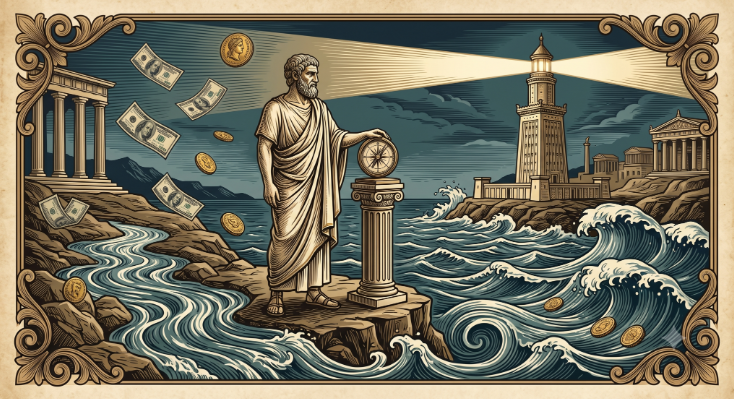
Introduction: Everything Changes
“Everything changes, and nothing remains still. The only constant is change itself.”
Heraclitus, Ancient Greek Philosopher
This declaration is not only the truth of human life, but also the simplest truth I hold—the most perfect truth that pierces through the rough sea of capitalism. The food we ate yesterday has changed in state today, and an idea that was brilliant a week ago may have a completely different level of importance today. Looking around the world, everything—AI technology, energy demands, geopolitical interests—changes from moment to moment, and even the value of fortress-like corporations in the stock market continuously shifts.
In a world that changes forever, clinging to a single, complex, and fixed hypothesis is a shortcut to ruin. Then, what weapon must we wield to cross this turbulent sea of change? The answer is clear. “The truth we hold must be extremely ‘simple’, and the thought process to verify it must happen ‘frequently’.”
1. Why You Must Think ‘Frequently’ Instead of ‘Deeply’
I realized this through the I Ching (Book of Changes) and got goosebumps when encountering recent neuroscience papers. This is because philosophy, which has posed fundamental “why” questions to humanity for over 2,500 years, has drawn the grand picture of the world first, even if not as precisely as science or mathematics. The only way to survive in a constantly changing environment is not to stubbornly dig deep into a single thought, but to maintain flexibility through light and frequent thinking. This is a truth universally proven by countless humanistic insights and philosophy over a long time.
- Neuroscience (Analysis Paralysis and Bayesian Inference): If you think too deeply for too long, the brain creates imaginary risks, leading to ‘analysis paralysis’ where choices become frozen. The human brain is not a tool that delivers perfect oracles; it is a ‘Bayesian inference engine’ that rapidly updates probabilities whenever new data arrives. Running short cycles frequently is the brain’s original mechanism.
- Computer Science & AI (Overfitting): If an AI model is trained too deeply on existing data (overfitting), its predictions will be completely wrong if the environment changes even slightly. That is why modern AI is not trained for long periods but undergoes ‘fine-tuning’ to frequently reflect newly incoming data.
- Business & Control Engineering (Agile and Feedback Loops): The Agile method, which repeats a 3-day hypothesis verification, yields a higher survival rate than a perfect 10-year master plan. Self-driving cars also reach their destination through feedback control—thinking very shallowly every 0.01 seconds and steering by detecting errors with sensors, rather than calculating a complex route for a long time.
- Eastern Philosophy (I Ching): I Ching (The Book of Changes) states, “When a thing reaches its limit, it changes; when it changes, it passes through; when it passes through, it endures.” Breaking the fixation of thought and giving it frequent variations is the absolute secret to enduring survival.
* Note: Being told to think frequently does not mean repeating the same agony over and over. It means constantly observing and inspecting the world from various angles and perspectives.
2. Why the Truth We Hold Must Be ‘Simple’
To move flexibly while frequently varying your thoughts, the focal point (truth) that anchors you must, paradoxically, be as simple as possible. Everyone probably remembers making grandiose vacation daily schedules. However, schedules tightly controlled by the hour fail without exception. I also tried setting numerous rules regarding reading, but when establishing the simplest standard—”reading a book for at least 10 minutes a day”—the volume of reading exploded. “This is because if the standard is complex, it tangles and easily collapses when the winds of change blow.”
Most people have likely had such experiences, yet why do they tie themselves down to complex technical indicators like Elliott Wave Theory, RSI, and MACD in the asset market? Elliott Wave Theory alone has evolved into a massive, brick-like book in modern times as exception rules were continuously added to account for market variables. Complex values and methodologies inevitably create contradictions when faced with a rapidly changing world.
Let’s look at Warren Buffett’s famous investment rules.
Rule No. 1: Never lose money.
Rule No. 2: Never forget rule No. 1.
These rules are simple enough for a primary school student to understand. People usually focus only on the first sentence, “Never lose money,” but the true essence of this quote lies not in the ‘money’ but in the ‘Rule’. Buffett said “never lose money” once, but emphasized the message to “keep the rule” twice.
Complex analysis or prediction is not the truth. The essence of truth is ‘never forgetting a single, simple rule’ that remains unshaken no matter how the world changes.
3. The Practical Mindset for Crossing the Sea of Capitalism
To establish a simple pillar and execute frequent thought, your mental attitude must also fundamentally change.
- The Trap of Deep Thought (Fixation): If you become overly attached to a deep hypothesis you built, you will be stubborn even when the market changes. As Mencius warned, “He who obeys the natural order of Heaven prospers; he who forces himself against it eventually exhausts himself and perishes,” heavily dropping anchor on a single thought only invites sinking.
- The Simplicity of Truth (Non-attachment): A heavily loaded ship is difficult to steer, but a light sailboat emptied of obsession can instantly adjust its sails whenever the wind direction changes. You must maintain the simplicity of ‘non-attachment’—not losing your mind entirely to capital—so you aren’t swayed by unnecessary side issues.
- Frequent Thought in Comfort (Equilibrium): Investing is not about overloading your brain and agonizing over it. Only when you drink a cold beer comfortably after work and feel a perfect state of equilibrium do the context of the world and the optimal ‘timing’ come into view. Consistently refreshing your awareness of market flows in the most harmonious and light state is the best approach.
Conclusion: You Must Empty Yourself to Ride the Change
Do not dig deep and fixate yourself. Instead, hold onto a single, simple principle you must protect, and observe the world comfortably and frequently in your daily life.
Only those who frequently observe the flow and meaning created by capitalism with a clear and light heart can snatch the opportunity without hesitation when the decisive ‘timing’ arrives.
Drop the anchor of simple truth, and raise the flexible sail of frequent thought.
“That alone will lead you to true freedom in this eternally changing sea.”