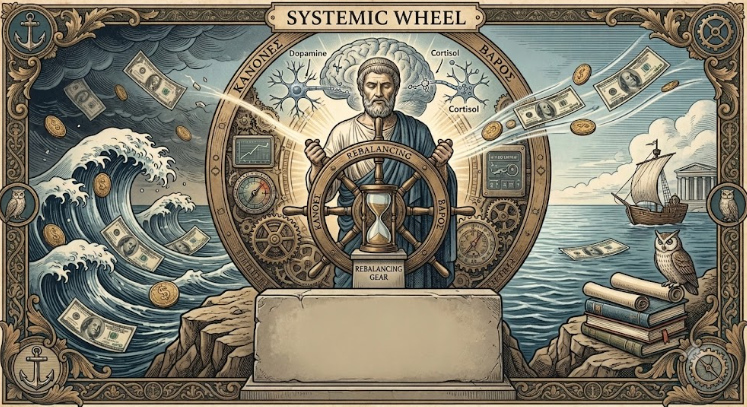
Introduction: The Human Brain Evolved Incompatibly with the Stock Market
“This article is not about recommending specific stocks or passing down short-term trading techniques. It is a daily record of protecting my mind amidst the market’s noise and volatility, and a system philosophy to protect myself.”
For millions of years, the human brain has been optimized to survive in primeval, wild environments. When the grass rustled, one intuitively concluded, “A lion has appeared,” and had to flee immediately to save their life.
The problem is that this survival mechanism becomes a fatal poison the moment it enters the modern stock market. If a chart flashes even a hint of a rally, the brain explodes with the dopamine of greed, and if it plunges, it releases the cortisol of fear, shutting off the switch of the prefrontal cortex. Attempting to predict future highs and lows in the ever-changing sea of capitalism is sheer arrogance. The moment a human tries to fight the market with emotion and intuition, defeat is already preordained.
According to data from the U.S. Financial Industry Regulatory Authority (FINRA) and major foreign media outlets like CNBC, the percentage of retail investors participating in ultra-short-term trading (day trading) who consistently generate profits for more than a year is merely in the top 1% to 3%. Transaction fees from frequent trading, tax burdens, and excessive turnover rates are pointed out as the main causes of account losses.
Source: CNBC reports and U.S. Financial Industry Regulatory Authority (FINRA) / SEC analysis data
1. Analysis Paralysis and the Vain Illusion of Prediction
Staring intently at charts and order books does not increase your probability of success. If you dig into your thoughts too deeply and heavily, the brain creates imaginary risks and countless variables that do not even exist, ultimately falling into ‘Analysis Paralysis’ where you cannot take a single step forward.
This is not just a problem in investing. It repeats exactly the same way in everyday life. You turn on an OTT platform to watch a movie once a month, only to spend a long time browsing through plots, ratings, and recommendation lists, eventually turning off the app without watching anything. It is the same when shopping online. You compare reviews and prices over and over again, only to pile items up in your shopping cart without ever pressing the purchase button.
An increase in the amount of information does not mean your judgment becomes sharper. Rather, the more choices there are, the more the brain becomes overloaded and decision-making simply becomes paralyzed.
The same applies to investing. We must break free from two illusions:
- The Trap of Prediction: No matter how many past indicators or auxiliary indicators you add, they are merely past data and cannot guarantee the future.
- The Limit of Rational Control: Even a human with a will of steel cannot withstand the fear response screamed by the amygdala in the brain when faced with continuous market crashes.
Ultimately, the amount of time and information invested does not necessarily lead to good results. Sometimes, boldly emptying your thoughts and choosing ‘simplicity’ creates the best outcome.
The truth we must grasp should be extremely simple. Instead of trusting our own weak willpower, we must hand over the steering wheel to a ‘mechanical system where my emotions cannot intervene.’ That is the only way to overcome analysis paralysis and fear, and emerge victorious.
2. The Only Way to Trick the Brain: Emotion-Free Rules
The only way we can control the brain’s dopamine and fear systems is to build an unconscious, automated system so that the brain does not even notice.
Just like Warren Buffett’s simplest principle, it is about setting a single, simple rule that operates regardless of market noise or your own emotions, and executing it mechanically.
Instead of becoming the subject who predicts and presses the trade button yourself, you design a ‘helmsman system’ that moves according to pre-set ratios and rules. When you isolate yourself from the noise of the market in this way, your brain finally unloads its overload and regains perfect equilibrium.
3. The True Weapon Attained Only by Those Who Abandon Prediction
In reality, for years, I have maintained a routine of completing a mechanical rebalancing in just 5 minutes every month according to set rules, and then closing the stock window. After doing this, the psychological wavering and anxiety I used to experience while looking at charts completely disappeared.
Stepping away from the game of guessing whether the market will go up or down, setting a ratio of aggressive assets to safe assets within my portfolio, and mechanically adjusting that ratio. This is the very wisdom that physically blocks the amygdala’s fear response and defends the sovereignty of my life amidst the storms of capitalism.
Because I operate solely by a system that completely excludes emotion, the blood-drying fear and psychological shaking I used to suffer when watching the pouring negative candles during past major market crashes cleanly vanished after building this system.
The interesting thing is that “deep reading, which stimulates the brain’s prefrontal cortex, took its place instead of charts.” As I broke the habit of looking at the stock window dozens of times a day and began filling that time with deep reading and intellectual exploration, I broke free from stimulating dopamine and gained a sophisticated sense of control provided by intellectual inquiry, allowing my investments and daily life to finally find absolute peace.
Rewiring the Dopamine Circuit (Seeking System): According to the ‘Seeking System’ theory by neuroscientist Dr. Jaak Panksepp, when you block the stimulating and unstable dopamine provided by chart monitoring, the brain shifts into a virtuous cycle circuit that secretes much more sustained and calm dopamine through intellectual exploration like reading.
Source: Dr. Jaak Panksepp’s neuroscience research and Seeking System theory analysis data
Conclusion: Turn on the System’s Switch and Close the Stock Window
Do not be overconfident in your rationality and willpower. Your brain was not designed to withstand market volatility.
Lay down the massive arrogance of prediction and build a mechanical weight-control system where emotions cannot intervene. Then, with the stock window closed, honestly trust the addition of time given every day and live your true life.
As my reading volume increased, I created a finish line where I would write a book about my past frustrations with investing.
Anyone you ask would say my direction is right. Will I succeed? It is impossible to fail.
This time is “a time to quietly reorganize my inner self for the next leap,” and because, as the true master of my life ‘in this very moment,’ I will truly and warmly embrace whatever I can grasp with my extended hands right now.
Now, it is time to witness the powerful mathematical alchemy of how we, who have abandoned prediction, can create something out of nothing through mechanical weight adjustments alone.
💡 Read Deeper with the Philosopher’s Eye
- 0. Capital Philosopher: A Philosophical Journey to Master Capital
- 1. How to Survive Unequal Capitalism: The Secret of Time You Didn’t Know
- 2. How to Survive the Ever-Changing Stock Market: Simple Truth and Frequent Thought
- 3. Give Meaning to Capital: Pierce the ‘Essence’ and Become the Master of Money
- 4. Why Philosophy Beats Trading Techniques in Capitalism